


| Name | Age | Position | |
|---|---|---|---|
| 1 | Iker Casillas | 29 | Goalkeeper |
| 12 | Victor Valdés | 28 | Goalkeeper |
| 23 | Pepe Reina | 27 | Goalkeeper |
| 2 | Raúl Albiol | 24 | Defender |
| 3 | Gerard Piqué | 23 | Defender |
| 4 | Carlos Marchena | 30 | Defender |
| 5 | Carles Puyol | 32 | Defender |
| 11 | Joan Capdevila | 32 | Defender |
| 15 | Sergio Ramos | 24 | Defender |
| 17 | Álvaro Arbeloa | 27 | Defender |
| 6 | Andrés Iniesta | 26 | Midfielder |
| 8 | Xavi | 30 | Midfielder |
| 10 | Cesc Fábregas | 23 | Midfielder |
| 14 | Xabi Alonso | 28 | Midfielder |
| 16 | Sergio Busquets | 21 | Midfielder |
| 20 | Javi Martínez | 21 | Midfielder |
| 21 | David Silva | 24 | Midfielder |
| 22 | Jesús Navas | 24 | Midfielder |
| 7 | David Villa | 28 | Attacker |
| 9 | Fernando Torres | 26 | Attacker |
| 13 | Juan Mata | 22 | Attacker |
| 18 | Pedro | 22 | Attacker |
| 19 | Fernando Llorente | 25 | Attacker |
Showing posts with label player. Show all posts
Showing posts with label player. Show all posts
Tuesday, July 6, 2010
2010 World Cup Spain Roster | WORLD CUP 2010
2010 World Cup Germany Roster | WORLD CUP 2010

| Name | Age | Position | |
|---|---|---|---|
| 1 | M. Neuer | 24 | Goalkeeper |
| 12 | T. Wiese | 28 | Goalkeeper |
| 22 | H. Butt | 36 | Goalkeeper |
| 2 | M. Jansen | 24 | Defender |
| 3 | A. Friedrich | 31 | Defender |
| 4 | D. Aogo | 23 | Defender |
| 5 | S. Taşçı | 23 | Defender |
| 14 | H. Badstuber | 21 | Defender |
| 16 | P. Lahm | 26 | Defender |
| 17 | P. Mertesacker | 25 | Defender |
| 20 | J. Boateng | 21 | Defender |
| 6 | S. Khedira | 23 | Midfielder |
| 7 | B. Schweinsteiger | 25 | Midfielder |
| 8 | M. Özil | 21 | Midfielder |
| 15 | P. Trochowski | 26 | Midfielder |
| 18 | T. Kroos | 20 | Midfielder |
| 21 | M. Marin | 21 | Midfielder |
| 9 | S. Kießling | 26 | Attacker |
| 10 | L. Podolski | 25 | Attacker |
| 11 | M. Klose | 32 | Attacker |
| 13 | T. Müller | 20 | Attacker |
| 19 | J. Claudemir da Silva | 29 | Attacker |
| 23 | M. Gómez | 24 | Attacker |
2010 World Cup Netherlands Roster | WORLD CUP 2010

| Name | Age | Position | |
|---|---|---|---|
| 1 | M. Stekelenburg | 27 | Goalkeeper |
| 16 | M. Vorm | 26 | Goalkeeper |
| 22 | S. Boschker | 39 | Goalkeeper |
| 2 | G. van der Wiel | 22 | Defender |
| 3 | J. Heitinga | 26 | Defender |
| 4 | J. Mathijsen | 30 | Defender |
| 12 | K. Boulahrouz | 28 | Defender |
| 13 | A. Ooijer | 35 | Defender |
| 15 | E. Braafheid | 27 | Defender |
| 5 | G. van Bronckhorst | 35 | Midfielder |
| 6 | M. van Bommel | 33 | Midfielder |
| 8 | N. de Jong | 25 | Midfielder |
| 10 | W. Sneijder | 26 | Midfielder |
| 11 | A. Robben | 26 | Midfielder |
| 14 | D. de Zeeuw | 27 | Midfielder |
| 17 | E. Elia | 23 | Midfielder |
| 18 | S. Schaars | 26 | Midfielder |
| 20 | I. Afellay | 24 | Midfielder |
| 23 | R. van der Vaart | 27 | Midfielder |
| 7 | D. Kuyt | 29 | Attacker |
| 9 | R. van Persie | 26 | Attacker |
| 19 | R. Babel | 23 | Attacker |
| 21 | K. Huntelaar | 26 | Attacker |
World Cup anti-stars shine for semifinalists | WORLD CUP 2010


CAPE TOWN, South Africa – Wayne Rooney looked like a lost little boy. Lionel Messi tried and fought and ran into a brick wall. Cristiano Ronaldo had two opponents, one on the field and one in his own head. Kaka lost his composure and his reputation as one of the world’s elite.
This World Cup is an ad man’s nightmare, a tournament where a determined posse of anti-superstars who got busy with preparation and focus instead of commercials and celebrity functions emerged as the heroes.
While the biggest names in the game have now fled the African continent to count their millions and dwell on their summer of failure, the leading lights from each of the final four teams are more than happy to duck so far under the radar that their backs almost scrape the ground.
Spain striker David Villa is a quiet and reserved family man whose idea of a wild night is attending a charity function with his childhood sweetheart wife. Here in South Africa, he has been the driving force behind the Spanish run to the semifinal with a tournament-leading five goals and inspired play that carries none of the flashiness of a Ronaldo or Messi but is ruthlessly efficient.
When Real Madrid shelled out $131 million for Ronaldo a year ago, a hefty chunk of that figure was a nod to the Portugal star’s commercial appeal. Barcelona paid Valencia $50 million for Villa this summer, yet every penny of that transfer fee was for his pure ability as a player. Villa doesn’t do fashion shoots or promote underwear in his spare time. He will win you matches, though. Lots of them.
“For me it is the football,” said Villa in an interview at the 2008 European Championships. “It is my life, my love, my passion, my drive.”
Germany’s Thomas Mueller did not even have a full professional contract a year ago before being promoted to the Bayern Munich first team and earning an international call-up after an inspired club season. Argentina coach Diego Maradona refused to share a stage with Mueller at a press conference before an exhibition game in March, but the 20-year-old Mueller had the last laugh with a spectacular performance Saturday to dump Argentina out in the quarterfinals.
Mueller has been the biggest breakout star of this World Cup. Little known outside his homeland before the tournament, he has become a midfield destroyer capable of launching devastating counterattacks. His suspension for the semifinal against Spain on Wednesday (due to yellow-card accumulation) is a huge blow for the Germans, yet Mueller retains his wide-eyed appreciation at the way his World Cup has unfolded.
“I could not have hoped for things to be as good as this,” he said. “You have expectations of yourself but sometimes it is easier to come in without people expecting a lot of you.”
The level of focus and public demand seemed to weigh heavily on soccer’s biggest stars, especially Rooney and Messi. Ronaldo is too wrapped up in his own universe to notice the scrutiny, while Kaka is used to the spotlight that follows Brazil everywhere but still could not raise his game.
The excuse made for several top stars was that they were exhausted from a full season with their European clubs. Yet that argument has been summarily blown out of the water by Wesley Sneijder, who has sparked the Netherlands to their first World Cup semifinal since 1998.
Sneijder played a full and productive campaign with Italian club Inter Milan, which benefited from his industry and impact to achieve an unprecedented trophy triple of the Italian league (Serie A) title, Italian Cup and, most notably, Champions League crown.
While the Dutch team is one of the more glamorous at the World Cup, Sneijder likes to play the role of the funny man. After his two-goal effort sunk Brazil in the quarterfinals, Sneijder was happy to poke fun at himself.
“The ball just slipped through from my bald head,” said the follicularly challenged 26-year-old of his winning header. “It was a great feeling.”
The only South American side left in the tournament is the biggest underdog of the bunch, Uruguay. And while Diego Forlan is the biggest star his homeland has produced in recent times, his career looked destined to falter when he failed to settle at one of the world’s highest-profile clubs.
Forlan’s move to Manchester United in 2002 was a disaster as he failed to score in his first 27 games and became a target for ridicule. On one famous occasion, no less than three English newspapers used the same headline to mock his plight – “Diego Forlorn.”
Forlan ended up resurrecting his career with Villarreal and Atletico Madrid, leading the latter to the Europa League title in May. Having guided Uruguay this deep into the World Cup, he is a realistic contender for the player of the tournament award.
“The attention has not been ours,” said Forlan, who has a co-team-high three goals in South Africa. “While everyone has been thinking about other teams we have swum through a net.”
Perhaps something was lost in translation but it is pretty clear Forlan meant the Uruguayans have ducked under the radar. Just like himself.
And just like the real stars of this World Cup, they have provided a timely reminder that hype and hoopla count for nothing in the heat of battle.
Friday, July 2, 2010
Home remedy cures ailing Messi | World Cup 2010

Lionel Messi’s mother has come up with an extraordinary plan to ensure the world’s best player is at peak fitness for Argentina’s World Cup quarterfinal against Germany on Saturday.
Garlic.
Messi’s battle with a cold and flu bug, which kept him out of a Thursday training session, has been a source of concern to the entire nation of Argentina, which understandably sees him as crucial to its hopes of reaching the semifinals.
However, Messi’s mom Celia Cuccitini reacted quickly by ordering her son to take a natural, garlic-based potion in order to ward off the symptoms of the condition.
Team doctor Donato Villani admitted he had “approved” the idea, although it is not known how much garlic Messi actually consumed.
“Messi has some flu-like symptoms but it is nothing important,” Villani said. “Everybody cares about him and wants him to feel his best. Of course everyone, his family, the team, we want him to feel better.”
Four years ago, Messi remained on the bench as an unused substitute and watched Argentina crash out against the Germans in a nerve-wracking penalty shootout at the same stage of the tournament.
Then-coach Jose Pekerman was widely criticized for not bringing Messi on and that snub has rankled with the 23-year-old ever since. The events of Thursday, when head coach Diego Maradona ordered him to skip training and rest, caused concern in the camp.
However, the home remedy appears to have had the desired effect. Team officials confirmed Friday that there was no reason Messi should not start against the Germans at Green Point Stadium in Cape Town.
Messi’s mother still cooks all of her son’s meals when he is in Spain with his club Barcelona and admits to keeping a watchful eye over his health and well-being.
“Lionel is the spoiled one of the family and of the national team,” she said. “Everyone is nice to him in the team. He is always happy and comfortable and has what he needs.”
Thursday, July 1, 2010
Stars looking to score | World Cup 2010

Football lovers everywhere went into the 2010 FIFA World Cup™ with burning hopes of seeing the game’s most illustrious stars parade their skills and light up the global stage with goals. The nets have certainly bulged across South Africa, with no fewer than 123 strikes buried so far, but the brightest talents have been conspicuously absent from the scoring charts.
Perhaps the most surprising player still grounded on zero efforts is Lionel Messi, the 2009 FIFA Player of the Year. Although there can be no doubt about the Barcelona forward’s massive contribution to Argentina’s quarter-final place, the outrageously gifted No10 is still waiting to open his account.
Given his Pichichi title as the Spanish Liga’s most prolific marksman last term, Messi’s failure to notch even one of La Albiceleste’s ten goals is almost bizarre, but the player himself is not unduly concerned. “It doesn’t worry me, even if I prefer to score when I play,” he said. “The most important thing is that we maintain the level we’re playing at and that we go on to win by playing as a team.”
Messi’s fellow South American star Kaka has fared no better on the goalscoring front, although the 2007 FIFA Player of the Year has set up three of Brazil’s eight goals so far, including Luis Fabiano’s effort against Chile in the Round of 16. Like his Argentinian rival, the Seleção playmaker prefers to focus on his team’s winning form than his own travails in front of goal. “My objective is to create goals and present the forwards with chances,” he said. “That’s how Robinho and Luis Fabiano have been able to score. I’m happy to have set up those goals and I hope to end the tournament as the player with the most assists and have Luis Fabiano finish as top scorer.”
While Messi and Kaka can certainly content themselves with their overall displays, the situation appears somewhat more worrying for Spain striker Fernando Torres, who has disputed 212 minutes at South Africa 2010 without adding to his international tally.
El Niño is still recovering from a knee operation in April that originally put his participation in doubt, but in-form fellow forward David Villa remains confident that the Liverpool man will soon rediscover his goalscoring touch. “I don’t think Torres’s performances have been poor, even if he hasn’t scored,” explained Villa. “He’s worked enormously hard to be here with us and we need to thank him for that, especially after his operation. Yes, strikers get judged on how many goals they score, but Fernando hasn’t had a lot of chances so far. He’s working, he’s progressing and you’ll see: the goals will come, like the one in the EURO 2008 final that won us the title.”
Torres will now be hoping to turn things around against Paraguay in the quarter-finals, when another pair of predators will also be determined to have their say. Manchester City’s Roque Santa Cruz and Benfica’s Oscar Cardozo – top scorer in Portugal last term – have both experienced a similar goal drought, no doubt partly due to coach Gerardo Martino’s conservative tactics.
While those players can all still make the difference, England’s Wayne Rooney can do nothing about his haul of zero strikes in four games. Three Lions fans expected much from the Manchester United icon following his 26 efforts in the Premier League last season, but he was unable to carry that bountiful form into the FIFA World Cup and England have now travelled home in the wake of their last-16 loss to Germany.
Likewise, Jozy Altidore was given 357 minutes of action for the United States without weighing in with a single goal, a frustration shared by France’s Franck Ribery, South Africa’s Steven Pienaar and Harry Kewell of Australia. Solovakia’s Marek Hamsik left empty-handed as well, unable to match his team-mate Robert Vittek, who currently shares pole position in the race for the adidas Golden Boot on four goals with David Villa and Gonzalo Higuain.
Wednesday, June 30, 2010
Diego GODIN | Uruguay

- Date of Birth: 16 February 1986
- Height: 185 cm
- Shirt number: 3
- Position: Defender
- Current club: Villarreal (ESP)
- International Caps: 41
- International Goals: 3
- First international: Mexico - Uruguay
(26 October 2005)
Club History
- Nacional (URU): From 2006 to 2007
- Cerro Porteño (PAR): From 2003 to 2006
Diego Godin is a composed and dependable central defender who is just as adept at snuffing out danger in the air as he is on the ground. His ability to make covering tackles is another feature of his game, and it was qualities such as those that made him an obvious choice to partner Diego Lugano at the heart of the Uruguayan defence throughout the recent South Africa 2010 qualifiers.
Godin’s long journey to becoming one half of one of the most formidable central-defensive duos in South America started when he gave up swimming at the age of 14 and turned his attention to football instead. Starting out in the youth team at Estudiantes of Rosario, the city of his birth, he continued his education in the junior ranks at Defensor Sporting before moving to Club Atletico Cerro in 2003, the year in which he played his first game in the top flight.
A commanding and reliable presence in the Albiceleste defence, Godin was quickly on his way to Nacional, helping them to victory in the 2007 Copa Libertadores play-off league and scoring two goals on their run to the quarter-finals of the Libertadores that same year.
His next move was to Spain and Villarreal, where he took his time to settle down before becoming a mainstay of the side, shining on both the domestic and European stage.
Jorge Fossati gave him his full international debut in a 2005 friendly defeat to Mexico, though it was after Fossati’s departure that Godin’s Uruguay career really began to take off. Oscar Tabarez identified him as a tried and trusted performer from the start, regularly selecting him for friendlies in 2006 and taking him to Venezuela for the 2007 Copa America, although he would only start one game there.
He left the bench behind at the beginning of the CONMEBOL qualifying competition for South Africa 2010, establishing himself as a first-choice in the side except when injury or suspension intervened.
Jorge FUCILE | Uruguay

- Date of Birth: 19 November 1984
- Height: 177 cm
- Shirt number: 4
- Position: Defender
- Current club: Porto (POR)
- International Caps: 27
- International Goals: 0
- First international: Romania - Uruguay
(23 May 2006)
Club History
- Liverpool (URU): From 2003 to 2006
rge Fucile’s qualities as a full back are obvious: he is a tight marker, has great ball control and loves to attack from deep. Add to that an ability to play on either side of the defence and you have a player of real quality.
A native of Montevideo, Fucile was barely 17 when he made his Uruguayan Second Division debut in 2002 for local outfit Liverpool FC. The following year saw his team gain promotion to the First Division where they even battled it out for the Uruguayan title, and over the next few seasons the team cemented their status in the top flight.
His reliability and commitment earned him an international call-up in May 2006. Just two months after taking the reins as head coach, El Maestro handed him his first cap in a 2-0 victory over Romania in a friendly match in Los Angeles.
By this time, Fucile was on the wish-list of a number of European clubs, so it came as little surprise when he signed for Porto in the summer of 2006. He quickly adapted to the Portuguese game, earning a starting place and crowning his arrival in Europe with his first league title in the 2006/2007 season.
Despite him turning out on the right side of defence for his club, Oscar Tabarez deployed Fucile on the left during the Copa America Venezuela 2007. He played the first four games of the tournament in this new role and proved himself more than up to the task, winning player of the tournament in his position. In 2008, however, he started to revert back to his original position on the right. Although missing out on the play-off win over Costa Rica due to injury, he still features strongly in Tabarez’s plans, and can be hopeful of getting the chance to prove his worth in South Africa.
Walter GARGANO | Uruguay

- Date of Birth: 23 July 1984
- Height: 168 cm
- Shirt number: 5
- Position: Midfielder
- Current club: Napoli (ITA)
- International Caps: 29
- International Goals: 0
- First international: Libya - Uruguay
(30 May 2006)
Club History
- Danubio (URU): From 2004 to 2007
What centre-half Walter Gargano might lack in stature, he more than makes up for with his insatiable appetite for hard work, his ability to time tackles and his ease on the ball. Capable of making the hard things look easy, Gargano is as reliable as they come.
Yet another product of the Danubio youth academy, the polished central defender played his first top-flight game for La Franja in 2003, going on to win the 2004 and 2006/07 league championships. That second triumph provided a springboard to Europe, where he joined Napoli, quickly becoming a valued member of the side.
Affectionately known as Mota, he has been a regular feature of the Uruguay side since he was first called up by Oscar Tabarez for the 2-1 friendly win over Libya in Tunis in May 2006.
A member of the squad that travelled to Venezuela for the 2007 Copa America, he came on as a substitute in three of Uruguay’s six games, sitting out the other three. But after watching the first two of his country’s South Africa 2010 qualifying matches, he was handed a starting place for their third game, remaining in the team until he was sidelined with injury in early 2009.
He eventually made his return in September, in time for the last four games in the group, although a further knock kept him out of the play-off against Costa Rica. Fitness permitting, he seems assured of a start in Uruguay’s opening game against France.
Spain reign as fullbacks climb | World Cup 2010

South American sides have turned 2010 FIFA World Cup South Africa™ into a demonstration of their own particular talents with the most impressive team performances up to now and all underlined by the dominance of their individual players in the Castrol Index. However Europe has begun to erode some of the ground claimed by the CONMEBOL nations early on and that is perfectly illustrated by the presence of Spain's two fullbacks at the head of the latest ratings.
Joan Capdevila has blossomed since joining Villarreal in 2007 and he was a mainstay of the team that lifted the UEFA EURO crown two years ago. In South Africa he has performed impressively in a team that has worked overtime to put the disappointment of their opening-game defeat by Switzerland to bed and deliver three much-improved subsequent performances in which they have conceded just one goal - to Chile - while marching on towards a last eight duel with Paraguay.
Often deployed as a left-midfielder earlier in his career, Capdevila's ability to attack effectively and send over accurate crosses has also helped him to score highly in the Castrol Iindex, an innovative system which uses the latest technology to objectively analyse and rank player performances and which is being used at the FIFA World Cup for the first time.
Ramos raider
Sergio Ramos is just as adventurous down the right, and La Roja's two raiding full-backs have had a large say in Spain's supremacy - by some distance - as the team delivering most crosses in the tournament. A total of 106 crosses were executed in their four games, which was 28 more than their closest rivals in that category, Germany. Spanish defenders have only conceded nine shots on target and two goals in four games, while Capdevila (81%) and Ramos (79%) also have above-average passing success rates for defenders.
Defenders fill the first five Castrol Index positions with the long-time leaders, Chile duo Gary Medel and Waldo Ponce, losing their pre-eminent positions after suspension ruled both out of their Round of 16 defeat to Brazil. However they have not been the only South American defenders to enhance that continent's fine reputation, with Paraguay's Antolin Alcaraz in third place and Argentina's Martin Demichelis fifth.
Alcaraz's ratings in each game have been high and remarkably consistent and he scored well again on Tuesday as Paraguay squeezed past Japan via a penalty shoot-out to earn a place in the quarter-finals, the first time they have advanced so far at a FIFA World Cup. The 27-year-old has made the fourth most clearances (10) of those players still in the competition.
Dividing the two CONMEBOL representatives is Philipp Lahm, who has demonstrated with a series of influential displays just why Germany coach Joachim Low turned to the Bayern Munich defender for his new captain when Michael Ballack dropped out through injury. Both Lahm and Demichelis are defenders who contribute in attack as well and their passing success rates (Lahm 82% and Demichelis 86%) are above-average for players at the back.
Gerrard on the move
Steven Gerrard and Juan also made big moves to put themselves in the top seven positions. Juan scored Brazil's opening goal against Chile on Monday while playing a full part in helping keep a clean sheet at the other end - Brazil's second in successive games. Like Uruguay, Brazil have only allowed opponents 12 shots on target.
England have had a campaign to forget but in Gerrard they had a player who need not reproach himself for their disappointing demise. He scored highly in Sunday's defeat by Germany, with Castrol Performance Analysts noting the crucial block he made on Miroslav Klose with the score at 2-1. In an attacking sense he was also influential and had a total of six shots in the game as he tried to haul England back into contention.
FIFA.com will be publishing the latest Castrol Index after every round of matches here at South Africa 2009, and in the meantime you can read more statistical analysis and delve deeper into this unique ranking system by following the links on the right.
Any questions on the Castrol Index? Anything you don't understand or puzzling you? Just click 'Add your comment' and we'll do our best to answer them here on FIFA.com over the coming days.
Paraguay boss desperate for goals | World Cup 2010

Paraguay face Spain in the FIFA World Cup™ quarter-finals on Saturday in desperate need of goals, having scored just three times through four matches.
All three of coach Gerardo Martino's favoured forwards play for top line clubs. Veteran Roque Santa Cruz is at English Premier League side Manchester City, while Lucas Barrios and Nelson Valdez are both at Bundesliga heavyweights Borussia Dortmund. But not one of Paraguay's meagre three goals has come from any of them.
Martino, who has guided the defensively rock solid South Americans to their first ever quarter-finals thanks to a penalty shoot-out win over Japan, came to South Africa in the knowledge that finding the back of the net would be tough. Salvador Cabanas, his top scorer from the qualifying stage, was shot in the head in a Mexican bar in January and is still recovering at home.
All the same, Martino would have been looking for a quick return on his faith in selecting Argentina-born Barrios, who qualified to play through his Paraguay-born mother, as he scored an impressive 19 goals in the Bundesliga. Yet, Barrios and his fellow strikers have found it impossible to unlock the defences of New Zealand, Italy, Slovakia and Japan but Martino, also Argentinian, refuses to lay the blame totally at their door.
"One mustn't be too hard on our strikers," said 47-year-old. "If they aren't scoring well maybe it's because the balls aren't arriving fast enough to them."
Martino also believes opposing teams have been negative in their approach. "I hope that our next opponent will allow us to play differently and it won't be simply down to us to dictate the game," he said. "Against Spain, we should have more space, because they play to win," added Martino, who has been in charge since February 2007.
Barrios shrugged off the goal drought by saying the Paraguyan team ethic was not based around the individual. "The important thing is not who scores the goals, but that we formed a united squad which was capable of reaching the quarter-finals for the first time in the history of Paraguay," said Barrios.
We’re all living in Maradona’s World Cup | World Cup 2010


JOHANNESBURG – Diego Maradona dominated the World Cup in 1986 like few players ever. Argentina won the event, of course, and Maradona was the awarded the Golden Ball as its best player. That was just a small part of it.
In a 2-1 quarterfinal victory over hated England, he scored twice in the disparate fashions that perfectly define him.
There was the “bad” – the illegal, self-described “Hand of God” goal when he purposefully punched the ball in. And there was the “good” – a spectacular, darting 50-yard run that was voted greatest in the history of the World Cup and hailed by many as the “Goal of the Century.”
And that was just one game.
In front of the media he was controversial and colorful and charismatic. He never backed down. He backed everything up. There was simply nothing like him.
In Argentina, some say, there is Eva Peron (“Evita”) and there is Maradona. He is some kind of Michael Jordan-Abraham Lincoln hybrid in his homeland’s history.
And now he’s back – nine lives, four World Cups, one friendship with Fidel Castro, a coke addiction (with multiple relapses), 100 pounds up and down (stomach stapled), a television career and who knows what else later.
It’s 1986 all over again. And while Maradona is wearing a gray suit and standing in the Argentine coaching box, not weaving through defenders, this World Cup is shaping up like that old one – all about Diego.
“I feel like I am putting on the jersey and going out on the pitch,” he said. “It’s beautiful. It’s beautiful indeed.”
His Argentinean team blasted through Mexico 3-1 on Sunday to set up a quarterfinal matchup Saturday against Germany, the 1986 runner-up (then just West Germany). It was a show of not just force but of spectacular ability – Carlos Tevez’s blast in the 52nd minute may be the prettiest goal of the event. Maradona’s team is playing brilliantly.
“They are doing the things perfectly well,” he said after.
Throughout it all, Maradona acted like Maradona, an over-caffeinated presence on the sideline and a stand-up comic in the press conference. He screams and cheers. He complains and cajoles. He smiles. He prays. He blesses himself. He hugs. Actually, he hugs a lot. He even kisses his players.
Pushing 50 yet wearing earrings and a salt-and-pepper goatee, he remains the biggest presence in the building – and that includes his megastar players such as Lionel Messi and Tevez.
“Victory always feels great,” Maradona said. “As a coach, as a player, there is not a major difference.”
As always it’s not what Maradona has done – getting his team to play as well as anyone. It’s how he’s done it.
He had no managerial experience when he got Argentina’s national team job in 2008. The man had been a wreck since his playing days (and even during them). He battled multiple addictions. He ate and ate. He had health issues, family issues, authority issues. He was distracted by politics.
Needless to say, organization was never a personal strong point.
So when he got the job, many in the media ridiculed the decision. When the team looked a mess during qualifying (Maradona used nearly 100 different players) they hit even harder. Diego Maradona as a coach? Diego Maradona as the calming influence on a team with so much talent and potential?
“Many journalists should apologize to the players,” he said last week, as Argentina rolled through group play. “I’m not suggesting you drop your trousers, but it would be honest and great so we all get along better.”
Yes, this is Diego Maradona. Don’t think that was his wildest quote of the World Cup, either.
When former Brazilian star Pele said Maradona was only coaching because he needed the money (which might be true since last year the Italian government claimed he still owed them $37 million euros in back taxes from his playing days there), Maradona couldn’t remain silent. He declared Pele should “go back to the museum.”
He got into a war of words with Union of European Football Associations president Michel Platini before dismissing Platini as arrogant – “That Platini, well, he’s French, what do you expect?”
He later apologized by saying, “[Platini] says he has never said what you [reporters] told me he said, so through you I would like to apologize to Mr. Platini … but not to Pele.”
Sunday’s press conference contained everything from his declaring a question “stupid,” reminiscing about being triple-teamed as a player, lamenting that as a coach he can’t swear on the sideline and asking that the questions (even stupid ones) continue since he was having so much fun talking.
“Finally I get a chance to speak and he wants to send me off,” he said of the moderator.
Each FIFA press conference features a game ball stationed next to the microphone. It’s nothing more than a decorative prop. When this session finally ended, Maradona stood up, stared at the ball and promptly scooped it up as walked off.
There was much laughter; Diego stole FIFA’s ball.
In the most curious way, all the fears of what Maradona would do and say at the World Cup have come true, yet not as a detriment to his team.
He’s been outlandish. He’s made this about himself. He’s picked fights and created trouble and made bold decisions that run in the face of fans and media (such as handing over the captainship to Messi, whose loyalty to the national team many fans have questioned due to previous subpar performances for the Albicelestes).
He has completely overshadowed his players.
Yet in doing so, he’s allowed his guys to stay out of the spotlight, to just shrug off the antics or their coach and laugh at the situation. Flying under the radar, with all the pressure on Diego Maradona, no one is playing looser, freer or with more confidence than the Argentineans.
“My relationship with the boys is excellent,” he said.
Just as when Maradona would make an open-field move that appeared too daring, too selfish and too risky only to find a way to make it brilliant, here he is again.
He actually may have even matured some. There was a brief, but quickly escalating, skirmish between some players at the end of the first half Sunday. Cursing and hair pulling were part of it. Maradona wasn’t offended by a potential fight. “What’s wrong with that?” he said.
Then again, he is the coach now so he raced to the middle of it and, quite surprisingly, busted it up. “We separated them before anything else could’ve happened,” he said.
Maradona the peacemaker?
We’ve seen it all. Except we’ve seen this act all before. It’s 2010. It’s 1986. It’s the World Cup shaping up to be all about Diego Maradona once again.
Sunday, June 27, 2010
David VILLA-Spain | World Cup 2010
2010 World Cup, football, soccer, USA, Portugal, Japan, Denmark, Uruguay, Paraguay, Italy, Côte d'Ivoire, Algeria, Argentina, Australia, Ghana, Brazil, Germany, France, England, Slovenia, Korea Republic, Mexico, Netherlands, Serbia, Slovakia, South Africa, Korea DPR, Cameroon, Chile, Côte d'Ivoire, Denmark, Italy, Japan, Portugal, USA, Uruguay, Switzerland, Honduras, Greece, New Zealand, Spain, Nigeria

Top scorer at UEFA EURO 2008 and a fixture at the sharp end of the Spanish attack, David Villa is currently one of the world's hottest striking properties. A born competitor with an unquenchable thirst for finding the net, Villa always has the goal in his sights whether playing as an out-and-out forward, in a withdrawn role or wide-left in a front three.
Known as El Guaje (an affectionate name given to children in his native Asturias), this quick and explosive hitman is certainly not afraid of hard work, and is always willing to drop deep and help out his midfield. It is this level of commitment and the gutsy nature of his performances that make the Valencia man a fan's favourite for club and country, as well as earning him his fair share of run-ins with match officials.
Naturally right-footed, Villa is nearly as proficient with his left, thanks to a childhood accident and his father's foresight. Seeing how his four-year old son would not stop playing even after bearing a plaster cast on his broken right leg, Villa senior felt it best to show the youngster how to strike the ball with his weaker foot.
Now 28, Villa came up through the youth ranks and began learning his trade at Sporting de Gijon, before exploding onto the La Liga scene at Real Zaragoza, where he enjoyed two goal-filled years between 2003 and 2005. Valencia then spent big to bring the front-runner to the Mestalla, though El Guaje quickly repaid the investment by coming within one goal of the division's top scorer's award, El Pichichi, in his debut campaign. He did however finish as the leading Spanish-born scorer, an honour he has since claimed on two further occasions.
After the 2009/2010 season, Villa signed with FC Barcelona and will now wear the vaunted blaugrana colours after helping Spain qualify simply for South Africa 2010. The Asturian made his debut for La Roja in February 2005, during Spain's successful qualifying campaign for the 2006 FIFA World Cup Germany™. And the tournament itself could barely have started better, with Villa notching twice in his country's 4-0 opening win over Ukraine. Despite Luis Aragones's side's exit from the competition in the Round of 16 against France, Villa's four-goal haul certainly did his own standing no harm whatsoever.
Since then, save for absences through injury or suspension, Villa has been an ever-present in La Roja squad and had already racked up 36 goals at the time of publication. Now second in Spain's all-time scorers' list, at his current rate Raul's record tally of 44 appears well within his reach.
Playing a part in his huge popularity is that, whatever plaudits and success come his way, Villa never fails to play down his own role and heap praise on those around him. And next up for Spain and their inspirational goal-getter is the sizable challenge of South Africa 2010, where he and his mates will be keen to make up for the disappointments of 2006.
Thomas MUELLER-Germany | World Cup 2010
2010 World Cup, football, soccer, USA, Portugal, Japan, Denmark, Uruguay, Paraguay, Italy, Côte d'Ivoire, Algeria, Argentina, Australia, Ghana, Brazil, Germany, France, England, Slovenia, Korea Republic, Mexico, Netherlands, Serbia, Slovakia, South Africa, Korea DPR, Cameroon, Chile, Côte d'Ivoire, Denmark, Italy, Japan, Portugal, USA, Uruguay, Switzerland, Honduras, Greece, New Zealand, Spain, Nigeria

There are easier surnames for a German footballer to possess than Muller, especially if you happen to be a Bayern Munich striker. There can be no avoiding comparisons with the legendary Gerd, from journalists and fans alike, but this eloquent and intelligent young man seems to have his feet firmly planted on the ground. Thomas Muller has exploded onto the top flight scene in his first full season as a pro, and surely has the potential to be a major discovery for Germany at the 2010 FIFA World Cup™.
A native of Upper Bavaria, Muller joined Bayern at the age of just ten. The German FA (DFB) quickly spotted his goal-scoring ability and highly effective playing style, handing him frequent appearances at junior international level. A fringe member of the senior squad in Munich from summer 2008, he received a first taste of Bundesliga and UEFA Champions League action under Jurgen Klinsmann. However, Muller’s stellar ascent began for real with Louis van Gaal’s arrival at Bayern. Searching for the right man to operate in the hole behind the central striker in a 4-5-1 formation, the Dutch supremo settled on the promising young reserve. The fast-starting 1.86m forward instantly became a first-team regular.
Muller repaid the coach’s faith with a total of 13 league goals, although the 20-year-old offers considerably more than effective finishing skill. Quite apart from pace, vision and exceptional technical ability for a relatively big man, he has demonstrated remarkable versatility, with more than creditable displays both in attacking midfield and wide on the flanks.
"I think I may be able to help, due to the way I like to keep it simple, potentially as a substitute. I can bring fresh impetus if things are getting bogged down," Muller told FIFA.com earlier this year. It was a typically astute comment, characteristic of his approach both on and off the field. He earned his first full cap in March 2010 in Germany’s 1-0 friendly defeat to Argentina in Munich, and represents a genuine alternative for national coach Joachim Low in South Africa.
Argentine team qualified for quarterfinals; Argentina vs. Mexico 3-1 | World Cup 2010
2010 World Cup, football, soccer, USA, Portugal, Japan, Denmark, Uruguay, Paraguay, Italy, Côte d'Ivoire, Algeria, Argentina, Australia, Ghana, Brazil, Germany, France, England, Slovenia, Korea Republic, Mexico, Netherlands, Serbia, Slovakia, South Africa, Korea DPR, Cameroon, Chile, Côte d'Ivoire, Denmark, Italy, Japan, Portugal, USA, Uruguay, Switzerland, Honduras, Greece, New Zealand, Spain, Nigeria

Argenitne team qualifies for 2010 World Cup quarterfinals, winning 3-1 in the match against Mexico.
As well as the first of today's match between Germany and England, this match also was marked by a disastrous referee mistake, who at the first goal for Argentina has not seen that Tevez was offside.
So, the first goal on the match scored Carlos Tevez in the 26th minute of the game, although Tevez was offside which was clearly visible (about 2 m). Until this moment Mexican team showed a great game, but this goal really shake them.
Soon the Argentines succeeded to score their second goal, in 32nd minute of the match, a scorer this time was Gonzalo Higuain. First half ended with 2-0 score.
In the second half, Argentine team additionally increased their advantage in the 52nd minute of the game. The scorrer again was Tevez, who has achieved a great goal from about 30 meters distance to the goal.
The only goal for the Mexican team scored Javier Hernandez in 71st minute of the match, and the final score was 3-1.
Maxi RODRIGUEZ-Argentina | World Cup 2010
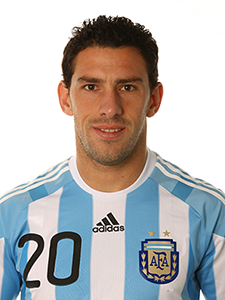
- Date of Birth: 2 January 1981
- Height: 173 cm
- Shirt number: 20
- Position: Midfielder
- Current club: Liverpool (ENG)
- International Caps: 39
- International Goals: 12
- First international: Japan - Argentina
(8 June 2003)
Club History
- Atlético Madrid (ESP): From 2005 to 2010
- RCD Espanyol (ESP): From 2002 to 2005
- Newell's Old Boys (ARG): From 1999 to 2002
A dynamic midfielder known for his powerful running and eye for goal, Maxi Rodriguez has brought all those qualities to bear for Argentina’s youth and senior teams and in the highly competitive Spanish and English top flights.
Starting his career at Newell’s Old Boys in 1999, he moved to Espanyol three years later. It was in Spain that he enjoyed the best years of his career to date, performing with distinction at Atletico Madrid, where he also sported the captain’s armband. Having fallen out of favour, however, he joined Liverpool at the start of the year, a switch brought about by his desire for regular first-team football in the build-up to the 2010 FIFA World Cup South Africa™.
Maxi has enjoyed many years of international service. He was a member of Jose Pekerman’s squad at the FIFA U-20 World Cup Argentina 2001, appearing in all seven games and scoring four goals to help the host nation claim the title.
Appointed national coach, Pekerman then selected him for the FIFA Confederations Cup Germany 2005 and the 2006 FIFA World Cup Germany. Maxi played in all five of La Albiceleste’s games in the world finals and scored the winner in the Round of 16 tie against Mexico, a spectacular left-foot volley following a superb piece of control. The strike was widely regarded as the goal of the tournament.
The midfielder featured in eight of Argentina’s qualifying matches for South Africa 2010, scoring once in the 4-0 defeat of Venezuela in March 2009, Diego Maradona’s official debut as national coach.
Rafael MARQUEZ-Mexico | World Cup 2010

- Date of Birth: 13 February 1979
- Height: 182 cm
- Shirt number: 4
- Position: Defender
- Current club: Barcelona (ESP)
- International Caps: 93
- International Goals: 11
- First international: Mexico - Ecuador
(5 February 1997)
Club History
- AS Monaco (FRA): From 1999 to 2003
- Atlas (MEX): From 1996 to 1999
He may have lost his place in the starting XI at Barcelona, but the best defender in Mexican football history remains vital to Javier Aguirre's plans.
Rafael Marquez is much more than just a footballer. He is captain of the Tricolor, one of the team's leaders both on and off the field, the starting point for Mexico's attacks and the man charged with frustrating opposition forwards.
From an early age, it was clear that the player the Mexican press have dubbed the "Kaiser of Michoacan" was going to be something special. His first call-up to the national team came when he was just 17. Within two years he was a fixture in the side that won the 1999 FIFA Confederations Cup on home soil, starting alongside the legendary Claudio Suarez in central defence in a pairing considered the best in Mexico's history.
That tournament over, Marquez headed for Europe to join AS Monaco, winning the French title at the end of his first season in 1999/00. After another three Ligue 1 campaigns in the principality, he became Joan Laporta's first signing as president of Barcelona.
Marquez quickly established himself in the first team at the Nou Camp, going on to collect a host of honours with the Azulgrana, including two UEFA Champions Leagues, three Spanish league titles, and one FIFA Club World Cup.
Success has been harder to come by with Mexico but he has been one of the symbols of the Tricolor team ever since his arrival in the national set-up. His first FIFA World Cup™ came in Korea/Japan in 2002 where he captained the side. He wore the armband again in Germany four years ago, and has also skippered his country at the CONMEBOL Copa America, CONCACAF Gold Cup and FIFA Confederations Cup.
South Africa will be his third appearance on world football's biggest stage and it will also be his last. Marquez has already announced his decision to retire from the international arena once the tournament is over, passing on the mantle to a younger generation and allowing himself to concentrate on his club career.
The 31-year-old differs from many defenders in that he is stronger with the ball than he is without it. He is a technically accomplished player with an impressive passing range. His ability to hit precise, long passes means he is often found starting Mexico's attacking play from his deep position. It also explains why he has sometimes featured in midfield for both his club and country.
In his defensive work, he is physically strong, solid in the air – a quality he employs in attack also – and has good positional sense. Despite the occasional blip, he is simply a world-class defender and will be one of Aguirre’s key players in South Africa.
Gerardo TORRADO-Mexico | World Cup 2010

For Javier Aguirre, Gerardo Torrado is one of Mexico's "three field marshals" along with Rafael Marquez and Cuauhtemoc Blanco.
Seeing him in action, it is impossible to question the coach's logic, for Torrado belongs to the breed of footballer that leads by example. A tenacious, terrier-like midfielder, he is forever snapping at opponents' heels in his desire to win the ball.
The Mexico No6 rose to prominence in 1999 when, without a single first-team appearance for his club side Pumas, he received a call-up to Manuel Lapuente's squad for the CONMEBOL Copa America on the back of some fine displays for the national Under-20 team. Torrado displayed a composure beyond his years in the tournament in Paraguay, even scoring a late equaliser against Peru in a quarter-final that Mexico won on penalties.
Soon after, he headed to Europe to join Tenerife, then in the Spanish second tier. Under coach Rafael Benitez, he played a pivotal role as Tenerife won promotion to the top flight in the 2000/01 season. Although the Mexican began the following campaign back in the second division with modest Polideportivo Ejido, before long he had the big opportunity he had been seeking with a move to Sevilla.
Torrado spent two full seasons in the Andalusian capital before heading north to Racing Santander for the 2004/05 campaign. After five years in Spain, however, the player they call 'Borrego' (lamb) for his curly head of hair decided to return home and signed for Cruz Azul, the club he now captains.
Torrado has been a fixture in the Mexico team for every coach he has worked under – even winning round Ricardo La Volpe, Mexico's trainer at Germany 2006. The midfielder had initially not featured in La Volpe's plans but the coach ended up handing Torrado three starts in Germany on his return to the world stage that he had first trod in 2002 when he was considered one of the best players in his position in Korea/Japan.
If fierce tackling and tireless effort are his trademark, Torrado is not lacking technical ability either. Mexico's attacking game is based on quick circulation of the ball, and he can certainly hold his own when it comes to crisp passing. Above all though, his team-mates know that when they do lose possession, he will be the one rushing to recover it.
Torrado has also earned attention for his changes of image. During his career, he has gone from an afro look to a short-back-and-sides to an entirely shaved head. The fact his skin is sensitive to the sun means he must wear sunblock when he plays, making him hard to miss. Mexico fans will hope their No6 catches the eye for other reasons at South Africa 2010.
Seeing him in action, it is impossible to question the coach's logic, for Torrado belongs to the breed of footballer that leads by example. A tenacious, terrier-like midfielder, he is forever snapping at opponents' heels in his desire to win the ball.
The Mexico No6 rose to prominence in 1999 when, without a single first-team appearance for his club side Pumas, he received a call-up to Manuel Lapuente's squad for the CONMEBOL Copa America on the back of some fine displays for the national Under-20 team. Torrado displayed a composure beyond his years in the tournament in Paraguay, even scoring a late equaliser against Peru in a quarter-final that Mexico won on penalties.
Soon after, he headed to Europe to join Tenerife, then in the Spanish second tier. Under coach Rafael Benitez, he played a pivotal role as Tenerife won promotion to the top flight in the 2000/01 season. Although the Mexican began the following campaign back in the second division with modest Polideportivo Ejido, before long he had the big opportunity he had been seeking with a move to Sevilla.
Torrado spent two full seasons in the Andalusian capital before heading north to Racing Santander for the 2004/05 campaign. After five years in Spain, however, the player they call 'Borrego' (lamb) for his curly head of hair decided to return home and signed for Cruz Azul, the club he now captains.
Torrado has been a fixture in the Mexico team for every coach he has worked under – even winning round Ricardo La Volpe, Mexico's trainer at Germany 2006. The midfielder had initially not featured in La Volpe's plans but the coach ended up handing Torrado three starts in Germany on his return to the world stage that he had first trod in 2002 when he was considered one of the best players in his position in Korea/Japan.
If fierce tackling and tireless effort are his trademark, Torrado is not lacking technical ability either. Mexico's attacking game is based on quick circulation of the ball, and he can certainly hold his own when it comes to crisp passing. Above all though, his team-mates know that when they do lose possession, he will be the one rushing to recover it.
Torrado has also earned attention for his changes of image. During his career, he has gone from an afro look to a short-back-and-sides to an entirely shaved head. The fact his skin is sensitive to the sun means he must wear sunblock when he plays, making him hard to miss. Mexico fans will hope their No6 catches the eye for other reasons at South Africa 2010.
Wednesday, June 16, 2010
World Cup 2010: Yakubu Confident Nigeria Will Progress To Second Round
2010 World Cup, football, soccer, USA, Portugal, Japan, Denmark, Uruguay, Paraguay, Italy, Côte d'Ivoire, Algeria, Argentina, Australia, Ghana, Brazil, Germany, France, England, Slovenia, Korea Republic, Mexico, Netherlands, Serbia, Slovakia, South Africa, Korea DPR, Cameroon, Chile, Côte d'Ivoire, Denmark, Italy, Japan, Portugal, USA, Uruguay, Switzerland, Honduras, Greece, New Zealand, Spain, Nigeria

Yakubu Aiyegbeni
Nigeria striker Yakubu has vowed to make the Super Eagles’ doubters eat their words and help his country qualify from World Cup Group B.
“People were writing us off even before the tournament started, but I think we made some people eat their words,” he told Fifa.com.
“We gave as good as we got against one of the best teams in the world,” he said of his side’s 1-0 defeat to Argentina last weekend. “We have what it takes to reach the next round.”
The 27-year-old Everton striker went on to say that he was happy with his performance in the competition so far and that he would do everything in his power to make his country proud.
“As a striker you're always under pressure to score goals,” he said.
“You can play well and contribute, but if you don't put the ball in the net people will criticise you and say you're not doing the right things. I want to get goals more than anybody to make the people back home in Nigeria happy.”
Nigeria continue their World Cup campaign against Greece tomorrow afternoon.
Friday, September 4, 2009
chelsea player and portugal national team player Deco with chinese tattoos in back
 chelsea player and portugal national team player Deco with chinese tattoos in back
src: http://i132.photobucket.com


